

Military Uniform Contracts and Tender Bidding Guide

Introduction: From Opportunity To Contract Delivery
Military uniform contract work begins by identifying the correct notice, confirming the buyer’s scope, and reviewing the complete solicitation package before a bid, quotation, or sample plan is prepared.
The controlling solicitation decides which specifications, clauses, registrations, evidence, samples, tests, certifications, domestic-source rules, and submission steps apply. No requirement should be inferred from this guide alone.
Uniform Supply Contracts And RFPs: Direct Answer
Direct answer: Use this Contracts Guide when "uniform contracts" means a garment-supply contract, uniform RFP, tender process, bid-readiness review, or contract-execution planning. The U.S. federal Uniform Contract Format is not a WHCSJ contract template or legal guide. If a U.S. federal solicitation uses that format, follow the solicitation, the applicable FAR provisions, and qualified procurement or legal guidance.
Use the Procurement Guide for specification packs, tech packs, comparison criteria, and RFQ inputs; use the Military Uniform Supply Company page for supplier evaluation; and use Contact WHCSJ to submit a project-specific quotation request.
Military uniform bid readiness starts with the exact solicitation, every amendment, specification attachment, bidder instruction, evaluation method, required evidence, and submission deadline. Build a compliance matrix before pricing or sampling, assign an owner to every requirement, and ask the contracting contact to clarify unresolved items.
Requirements are solicitation-specific. Do not assume a standard, registration, certification, test, domestic-source rule, sample, or past-performance document applies unless the controlling solicitation or applicable law requires it.
Bid Readiness Matrix
| Review area | Procurement team | Bidder or manufacturer | Evidence or question |
|---|---|---|---|
| Scope and line items | Confirm item numbers, quantities, destinations, options, and buyer-furnished references. | Map each line item to feasible materials, construction, sizing, and production ownership. | Current scope, amendment list, quantity schedule, and unresolved item questions. |
| Specifications and clauses | Identify incorporated specifications, revisions, clauses, and precedence rules. | Crosswalk each requirement to an owner, proposed evidence, exception, or clarification request. | Specification files, clause matrix, reference samples, drawings, and version conflicts. |
| Eligibility and documents | List only the registrations, representations, licenses, certifications, and past-performance evidence the solicitation requires. | Confirm the responsible party and whether every requested document is current and supportable. | Eligibility checklist, document owner, expiry date, evidence gap, or no-bid condition. |
| Samples and testing | Define sample quantity, approval authority, test method, timing, and production-release condition when specified. | Plan materials, pattern, workmanship, traceability, inspection, test records, and resubmission time. | Approved reference, test protocol, acceptance record, lead time, and open technical question. |
| Pricing and delivery | Confirm price format, currency, Incoterms, destination, delivery windows, options, and evaluation basis. | Validate material assumptions, minimums, capacity, production lead time, packing, freight, and schedule risk. | Cost assumptions, exclusions, delivery plan, dependencies, and clarification response. |
| Quality, packing, and acceptance | State inspection points, acceptance criteria, labeling, marking, packing, documentation, and remedy terms. | Assign controls for incoming material, in-process work, final inspection, cartons, records, and release. | Inspection plan, approved label and carton data, acceptance evidence, and deviation process. |
The controlling solicitation decides whether Mil-Spec, Berry Amendment, FAR, DFARS, domestic-source, registration, certification, laboratory testing, first-article, licensing, tax, or past-performance requirements apply. Record the exact source for each requirement and do not treat this guide as eligibility or compliance evidence.
Sample And Production Planning

When samples or first articles are required, confirm the quantity, materials, construction, marking, test method, review authority, approval record, schedule, and whether bulk production may begin before written acceptance.
Review Tender Files With WHCSJ
WHCSJ can review buyer-supplied specifications, samples, fabric and color references, sizes, labels, packing instructions, inspection points, production planning, and delivery information before confirming feasibility and quotation. This support is not proof of bid eligibility, registration, certification, award status, official supplier status, or compliance with a requirement that has not been reviewed for the specific project.
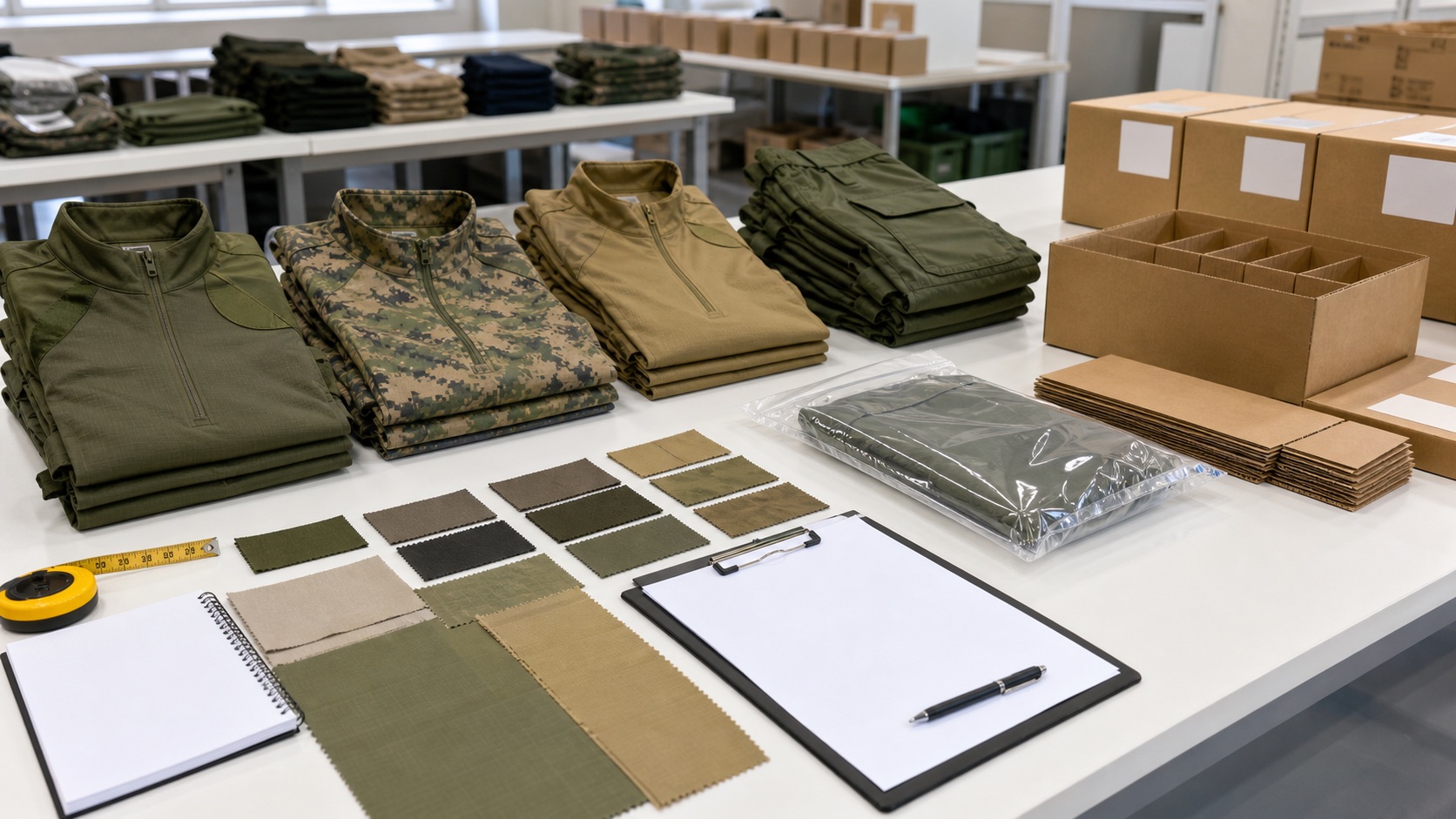
Use the military uniform procurement guide for RFQ preparation, the military uniform supply company page for supplier evaluation, Custom Services for design-to-sample review, and Contact WHCSJ to submit tender files for feasibility and quotation review.
Buyer FAQs
- Which requirements apply to a military uniform bid?
- Only the requirements incorporated by the controlling solicitation, its amendments, the resulting contract, and applicable law apply. Verify the exact version, clause, evidence, and responsible party for each item.
- What belongs in a bid/no-bid review?
- Confirm scope fit, bidder eligibility, required evidence, technical feasibility, sample and test timing, price assumptions, capacity, delivery, acceptance terms, unresolved questions, and the conditions that require a no-bid decision.
- How should teams handle an unclear or missing requirement?
- Record the gap in the compliance matrix, assign an owner, submit a clarification through the authorized procurement channel, and do not price or claim compliance from an unsupported assumption.
- When are samples or first-article tests required?
- They are required only when the solicitation or contract specifies them. Confirm quantity, timing, test method, approval authority, acceptance evidence, and production-release conditions.
- What should buyers send WHCSJ for feasibility and quotation review?
- Send the relevant solicitation sections and amendments, specifications, quantities, size breakdown, sample or image references, fabric and color requirements, labels, packing and inspection requirements, delivery destination, and response deadline.
Where To Find Relevant Military Uniform Contract Notices
Start by identifying notices that match the required uniform items, buyer, delivery region, timetable, and bidder role.
The Core Platform: SAM.gov (System for Award Management)
SAM.gov is a primary source for U.S. federal opportunities. Other public buyers, prime contractors, and jurisdictions use different portals and thresholds, so verify the issuing authority and the controlling notice before relying on any registration or publication rule.
Search Techniques:
- Keywords: Use precise keywords for your search, such as “military uniforms RFP” (Request for Proposal), “combat uniforms bid,” or “ACU contract.”
- NAICS Codes: Filter using North American Industry Classification System codes, for instance, 315210 (Cut and Sew Apparel Contractors) or 315220 (Men’s and Boys’ Cut and Sew Apparel Manufacturing).
Understanding Solicitation Types:
- RFP (Request for Proposal): The military has a clear need but wants contractors to provide a detailed technical and management solution.
- RFQ (Request for Quotation): Typically used for standardized products where price is the primary determining factor.
- IFB (Invitation for Bids): Similar to an RFQ, the contract is usually awarded to the lowest bidder who meets all requirements.
How To Review A Military Uniform Solicitation
Review the complete solicitation, amendments, attachments, bidder instructions, evaluation method, required evidence, and submission deadline. Build a clause and specification crosswalk before deciding whether to bid.
- Scope of Work (SOW): This is the overall description of the contract. For example, you might see an attachment named “Exhibit 3: Uniforms Scope.pdf,” which defines the procurement goals, uniform types, quantities, and basic delivery requirements.
- Technical Specifications: This is the most critical section, where the devil is in the details. It will specify fabric types (e.g., NYCO 50/50 Ripstop), weight, color codes (like the PANTONE numbers for OCP), sewing standards, button/zipper specs, and more.
- Requirements and clauses: Record each cited standard, clause, domestic-source rule, registration, certification, and evidence requirement exactly as written. Berry Amendment, FAR, DFARS, and other rules apply only when the controlling solicitation or applicable law makes them relevant.
- Evaluation Criteria: This openly informs you of the criteria the military will use to judge your proposal. It’s often a comprehensive assessment of technical merit, past performance, management capability, and price—not just the lowest price.
Specification And Clause Review: Follow The Solicitation
Technical requirements come from the solicitation and its incorporated specifications. When a tender cites a Mil-Spec, drawing, sample, stitch requirement, material standard, or test method, record the exact revision and acceptance evidence instead of assuming a universal rule.
- Stitch Density: How many stitches per inch are required.
- Thread Type: Use of specific-grade and high-tensile nylon thread is mandatory.
- Reinforcement: “Bar-tacking” reinforcement is required at high-stress points like pockets and crotches.
WHCSJ can review buyer-supplied specifications, samples, fabric and color references, sizes, labels, packing instructions, inspection points, production planning, and delivery information before confirming feasibility and quotation. This support is not proof of bid eligibility, registration, certification, award status, official supplier status, or compliance with a requirement that has not been reviewed for the specific project.
How Buyers And Bidders Assess Readiness
Use the stated evaluation method rather than assuming which factor will decide an award. The solicitation may evaluate price, technical response, past performance, delivery, quality planning, responsibility, or another documented criterion.
- Past Performance: Can you provide evidence that you or your manufacturing partner have successfully delivered projects of similar scale and complexity in the past?
- Production Capacity & Supply Chain Security: Can you demonstrate that you have a reliable manufacturing partner and supply chain capable of handling large-volume production and potential risks?
- Quality Control Plan: Have you submitted a detailed and credible plan outlining how you will manage quality throughout the entire process, from raw materials to finished products?
After Award: Samples, Approval, Production, And Delivery
After award, follow the contract, approved changes, inspection plan, and delivery schedule. Sample approval or first-article activity is required only when the contract specifies it.
- Samples or first articles: When specified, confirm quantity, construction, test method, approval authority, timing, disposition, and whether production may start before written acceptance.
- Production and delivery: After feasibility review, align material approvals, production checkpoints, inspection records, packing and marking, shipment documents, and delivery milestones with the accepted contract requirements.
Choosing And Verifying A Manufacturing Partner
A manufacturing partner should be assessed against the specific project’s scope, evidence needs, sample plan, production controls, inspection points, packing requirements, capacity, and delivery information.
WHCSJ reviews the buyer-supplied tender files before confirming what can be quoted, sampled, produced, inspected, packed, and delivered. The bidder remains responsible for eligibility, representations, proposal content, and compliance with the controlling solicitation.
Send the relevant solicitation sections, specifications, quantities, size breakdown, sample references, packing requirements, delivery destination, and deadline for a feasibility and quotation review.